
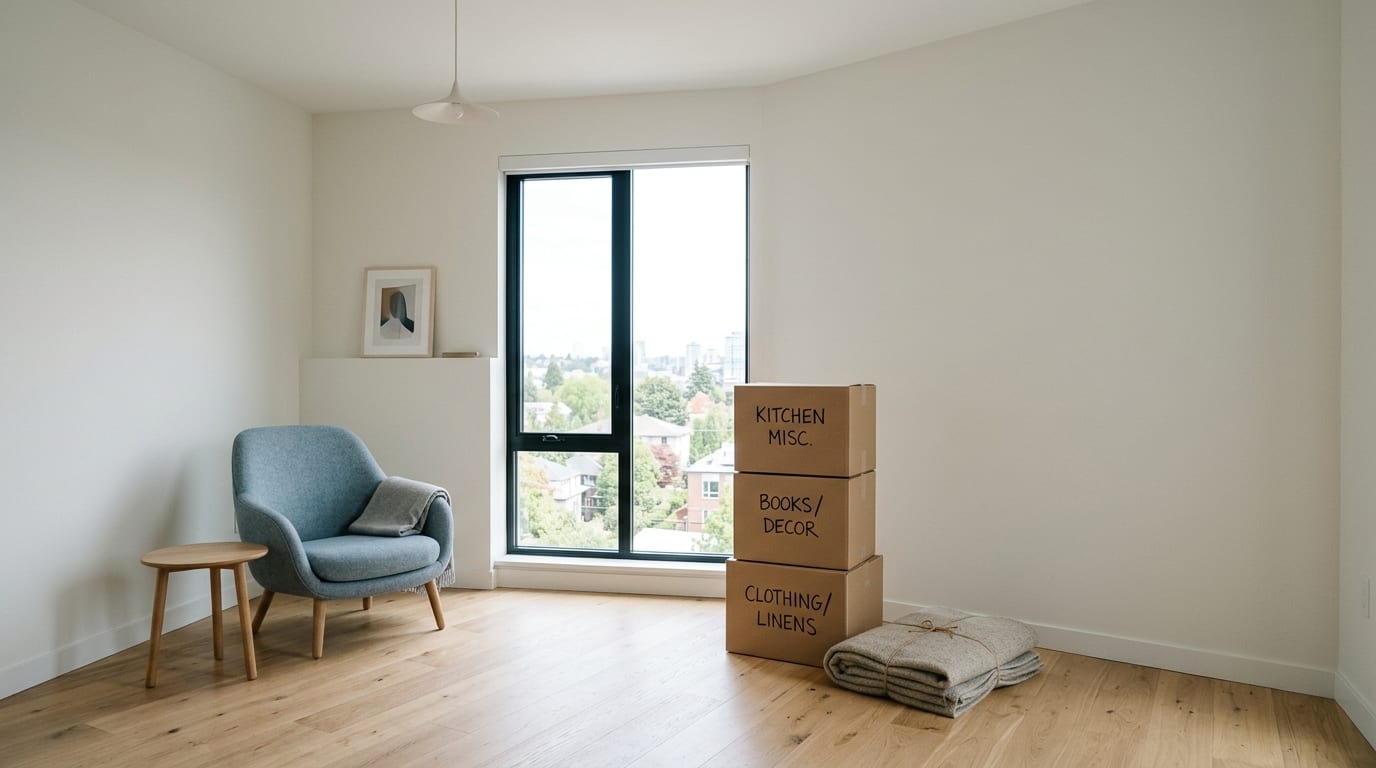
You gave notice on the two-bedroom and signed a lease on a studio 400 square feet smaller. Now you're standing in your living room doing math you didn't sign up for: where does the dining table go, what happens to the guest bed nobody's slept in since 2023, and why does it suddenly feel like you own more stuff than humanly possible.
That panic is normal, and it's also solvable. Downsizing your apartment isn't really a packing problem — it's a decision problem. Once you know what to keep, what to let go of, and what to put in storage until you actually need it, the rest is logistics.
This is the 2026 version of how to downsize your apartment: what's driving the move to smaller apartments right now, a realistic timeline, a keep/donate/store framework that works in small spaces, and the actual unit-size math for what doesn't fit.
Why are more renters downsizing their apartments in 2026?
Rent growth has cooled off. Heading into 2026, rents fell year-over-year in several major metros, and rent affordability improved to roughly its best level in about four years, according to CNBC's coverage of Zillow rental data. That's a genuinely renter-friendly market, one of the better ones in a decade.
But "friendlier" doesn't mean cheap, and a lot of renters are still trading square footage for a lower monthly number. If a one-bedroom in your building runs a few hundred dollars more than a studio, and you're not using half of what's in your current place anyway, downsizing is a straightforward way to cut a fixed cost that doesn't move much otherwise.
The other driver is life stage. Empty nesters right-sizing after kids move out, roommates splitting up and each renting solo, and people relocating for a lower cost of living are all doing the same math: less space, less rent, more flexibility.
Whatever the reason, the challenge is identical: you have a fixed amount of stuff and a smaller box to put it in.
How far in advance should you start downsizing before a move?
Start purging at least one month before moving day. Two to three months is better, especially if you're going from a one-bedroom or larger down to a studio.
The reason to start early isn't just about having time to pack. It's that decluttering under deadline pressure makes you either keep everything (because deciding is exhausting) or throw away things you'll regret (because you're rushing). Neither is good.
A simple pace that works: one room, closet, or drawer per day. At that rate, a full apartment is done in two to three weeks, with time left over to sell things, schedule a donation pickup, or book a storage unit before the truck shows up.
-
Weeks 8–6 before moving day: Measure your new apartment (see below), then start with low-emotion zones — the junk drawer, the hall closet, under the bathroom sink. Nothing here should take you more than 15 minutes a day.
-
Weeks 5–3 before moving day: Move into bedrooms, kitchen cabinets, and closets. This is where the volume is, and where the one-year rule earns its keep: if you haven't used it in the last 12 months, it's a strong candidate to donate, sell, or store.
-
Weeks 2–1 before moving day: Tackle sentimental items and anything you've been avoiding — old photos, keepsakes, gear from a hobby you don't do anymore. Do this last, when you have the bandwidth to actually think it through instead of rushing.
-
Final week: Book your storage unit, confirm building move logistics (freight elevator, loading dock, COI), and pack what's left.
How do you decide what to keep, sell, donate, or store?
The classic four-box method — keep, donate, sell, trash — works, but it adds a decision most apartment dwellers don't need. Selling things takes time you probably don't have during a move, and "trash" is really just a subset of "donate" for anything not literally broken.
The simpler version, adapted for small-space living: Keep, Donate, or Store.
- Keep what you use regularly and what fits the new place. If you haven't touched it in a year, it doesn't automatically qualify just because you might, someday.
- Donate what's in good shape but you won't use again. Someone else's "still useful" beats your closet's "just in case."
- Store what you'd genuinely regret losing but doesn't have a home in the smaller apartment right now — winter gear in a warm-weather move, the good cookware you only use for holidays, furniture you'll want again once you're not sharing 500 square feet.
The test that cuts through most indecision is the sunk-cost reframe: would you buy this again, today, for the apartment you're moving into — not the one you're leaving? If the honest answer is no, it goes in the donate or store pile, not back in a box for the new place.
We go deeper on this exact framework, including how to run it room by room, in our guide to decluttering with the keep-donate-store method.
Measure before you decide. Before you touch a single closet, measure your new apartment: doorway and hallway widths, ceiling height, closet dimensions, and where your biggest furniture would actually go. It's much easier to let go of a couch when you know, for a fact, it won't fit through the door — no emotional debate required.
What size storage unit do you need when downsizing?
Once you've sorted, whatever's left in the "store" pile needs a home. Storage unit sizing scales pretty predictably with how far down you're moving, and if you haven't picked a facility yet, our guide to choosing a self-storage facility covers what to check before you book.
Here's what each size realistically holds:
- 5x5 (25 sq ft): A walk-in closet's worth of stuff — seasonal clothing, boxes, sports gear, a couple of bikes. Fine if you're moving to a studio and only shedding the overflow, not the furniture.
- 5x10 (50 sq ft): The workhorse for a studio downsize. Fits a queen mattress, a small sofa, a dresser, and roughly 20 to 30 boxes.
- 10x10 (100 sq ft): What most one-bedroom-to-studio or one-bedroom-to-smaller-one-bedroom moves need. Holds a bed, sofa, dresser, dining set, and 50 to 75 boxes.
- 10x15 (150 sq ft): Only go here if you're storing oversized pieces — a sectional, a full dining set for eight, large appliances — rather than a straightforward apartment's worth of furniture.
Storage pricing varies a lot by market — location tends to matter more than size once you're comparing the same-size unit across cities — so treat any single number as a rough, national-average starting point rather than what you'll actually pay. Our breakdown of self-storage costs has more detail on what drives the range in your area. And if this is your first time renting a unit, our guide to renting storage space walks through the process end to end.
Figured out what you're storing?
Search available units near your new place and reserve in a few minutes.
How do you make furniture fit a smaller apartment?
Downsizing furniture is really a math problem disguised as a design problem. A smaller apartment doesn't just mean less floor space — it usually means narrower hallways, lower ceilings, and closets that weren't built for a full linen collection.
A few moves that actually make a difference:
- Multi-function furniture first. Storage ottomans, beds with built-in drawers, and folding or extendable dining tables do the work of two pieces in the footprint of one. This is the single highest-leverage upgrade for a small apartment.
- Go vertical. Wall-mounted shelving and tall, narrow bookcases use space nobody's fighting you for. Floor space is scarce in a small apartment; wall space usually isn't.
- Measure before you buy or keep anything big. The same measurements you took before decluttering — doorways, hallways, ceiling height — should decide which furniture makes the cut. If the couch won't clear the hallway turn, it doesn't matter how much you like it.
- Store, don't sell, furniture you'll want again. If you're downsizing temporarily — between leases, saving for a bigger place, splitting from a roommate — a storage unit keeps good furniture out of a Facebook Marketplace fire sale you'll regret in a year.
Our guide to creative storage solutions for small apartments has more room-by-room ideas for stretching a smaller footprint.
Don't forget the building logistics
If you're moving within or into a building with a doorman, elevator, or loading dock, check the move-in requirements about a week ahead — not the night before. Most buildings require you to book a freight elevator window in advance, and many require a certificate of insurance (COI) from your mover before they'll let a truck near the loading dock. Confirm truck parking rules too; alternate-side parking or a lack of a dedicated loading zone can turn a two-hour move into a four-hour one.
What should you do with sentimental items you can't take with you?
Not everything sentimental needs to survive as a physical object in your new, smaller apartment. Before you store or let go of anything with memory attached, photograph it. A well-lit photo of your kid's artwork, your grandmother's dishes, or the concert posters from college preserves the memory without the box.
For the handful of items where the physical object actually matters — the dishes themselves, not just a photo of them — a small memory box or a dedicated shelf in a storage unit works better than scattering sentimental things across drawers in an apartment that doesn't have room for them. Store what you'd genuinely regret losing; let a photo stand in for the rest.
How much does downsizing actually save you?
The honest answer: it depends heavily on your market, and anyone who gives you one flat national number is oversimplifying. What's consistent is the shape of the trade-off.
In most cases, even after adding a small storage unit into the math, downsizing still comes out ahead, because rent is typically the larger line item by a wide margin. But it's not automatic — if you're only saving $100 a month on rent and need a large unit to hold the overflow, the math gets tighter. Do the comparison with real numbers from your own market before you commit, rather than assuming the savings will be dramatic.
If you're downsizing as a temporary bridge — between leases, waiting on a bigger place, riding out a job transition — our guide to using storage between moves walks through how to think about short-term versus long-term storage costs.
What are the most common downsizing mistakes to avoid?
- Decluttering by emotion instead of measurement. Measure the new place first. Let physics decide on big furniture before nostalgia gets a vote.
- Starting too late. A week isn't enough time to sort a full apartment thoughtfully. You'll either keep too much or regret what you tossed.
- Skipping the building logistics. Forgetting to book a freight elevator or arrange a COI can delay your move-in day entirely, storage plan or not.
- Storing before decluttering. A storage unit should hold what's left after you've made real decisions, not become the place where undecided stuff goes to avoid the decision. If you're storing more than you're actually keeping in the apartment, it's worth another pass.
- Guessing on unit size. Oversizing means paying for empty space; undersizing means a second trip or a unit upgrade mid-lease. Use the room-by-room math above before you book.
Our rundown of common moving mistakes covers more of the logistics side if you're deep in move planning already.
Modern storage when & where you need it.
No hidden fees. Cancel anytime. Phone-based access.
Frequently Asked Questions
What size storage unit do I need to downsize from a one-bedroom to a studio?
Most people moving from a one-bedroom to a studio need a 5x10 unit, which holds a queen mattress, a small sofa, a dresser, and 20 to 30 boxes. If you're keeping more furniture than that, or your studio is on the smaller side, size up to a 10x10.
How long before a move should I start decluttering?
Start at least one month ahead, ideally two to three months if you're downsizing significantly. Pace yourself at one room, closet, or drawer per day rather than trying to sort an entire apartment in a weekend.
Should I sell my furniture or put it in storage when downsizing?
If you'll want the piece again — after a temporary downsize, a job transition, or a move you expect to reverse — storage usually makes more sense than selling and rebuying later. If you genuinely won't use it again in the space you're moving toward, selling or donating is the better call.
What's the one-year rule for decluttering?
If you haven't used an item in the past 12 months, it's a strong candidate to donate, sell, or store rather than move into your new, smaller apartment. It's not an absolute rule — genuinely seasonal items are an obvious exception — but it's a useful default when you're stuck deciding.
How do I handle sentimental items I can't fit in a smaller apartment?
Photograph items where the memory matters more than the object — kids' artwork, cards, event mementos — and keep the photos instead of the physical items. For the few things where the object itself matters, store them in a small memory box or a dedicated spot in a storage unit rather than letting them take over drawer space in your new apartment.