Table of Contents
- How Much Does a Cheap Storage Unit Cost in 2026?
- What Counts as a Cheap Storage Unit?
- Why Isn't the Cheapest Advertised Rate the Cheapest Storage?
- What does a 12-month storage bill really look like?
- Which Fees Change the Real Price?
- How Do I Find Cheap Storage Units Near Me?
- Where to search
- What's the Cheapest Way to Store Your Things?
- How do I pick the right size?
- Is storage cheaper in another neighborhood?
- Should I sign up month to month?
- Is a rate guarantee worth paying for?
- Where Can I Find Cheap Storage in San Francisco?
- Where Can I Find Cheap Storage in Los Angeles?
- Where Can I Find Cheap Storage in NYC?
- What About Washington DC, Seattle, Boston and Atlanta?
- The Cheapest Unit Is the One You'll Actually Use
- What does a Stuf unit cost over 12 months?
- How does access work?
- What are the rental terms?
- Frequently Asked Questions
In October 2026, a large national chain's Los Angeles listing advertised a 5x10 storage unit at $77 a month. Multiply that by twelve and you'd expect to pay $924 for the year. Read the terms on the same listing and the year actually comes to about $1,569, and that's the generous reading.
It's a normal move-in promotion, and for a four-month stay it may be a fair price. But it shows the one rule that matters most when you're hunting for cheap storage units: the cheapest advertised rate is often not the cheapest storage.
This guide covers what storage really costs in San Francisco, Los Angeles and New York, how to work out the 12-month price of any deal before you sign, and the honest ways to pay less, whichever company you rent from. We also run the same math on a real listing near the end.
Last updated October 2026. Prices checked October 20–21, 2026.
Key takeaways:
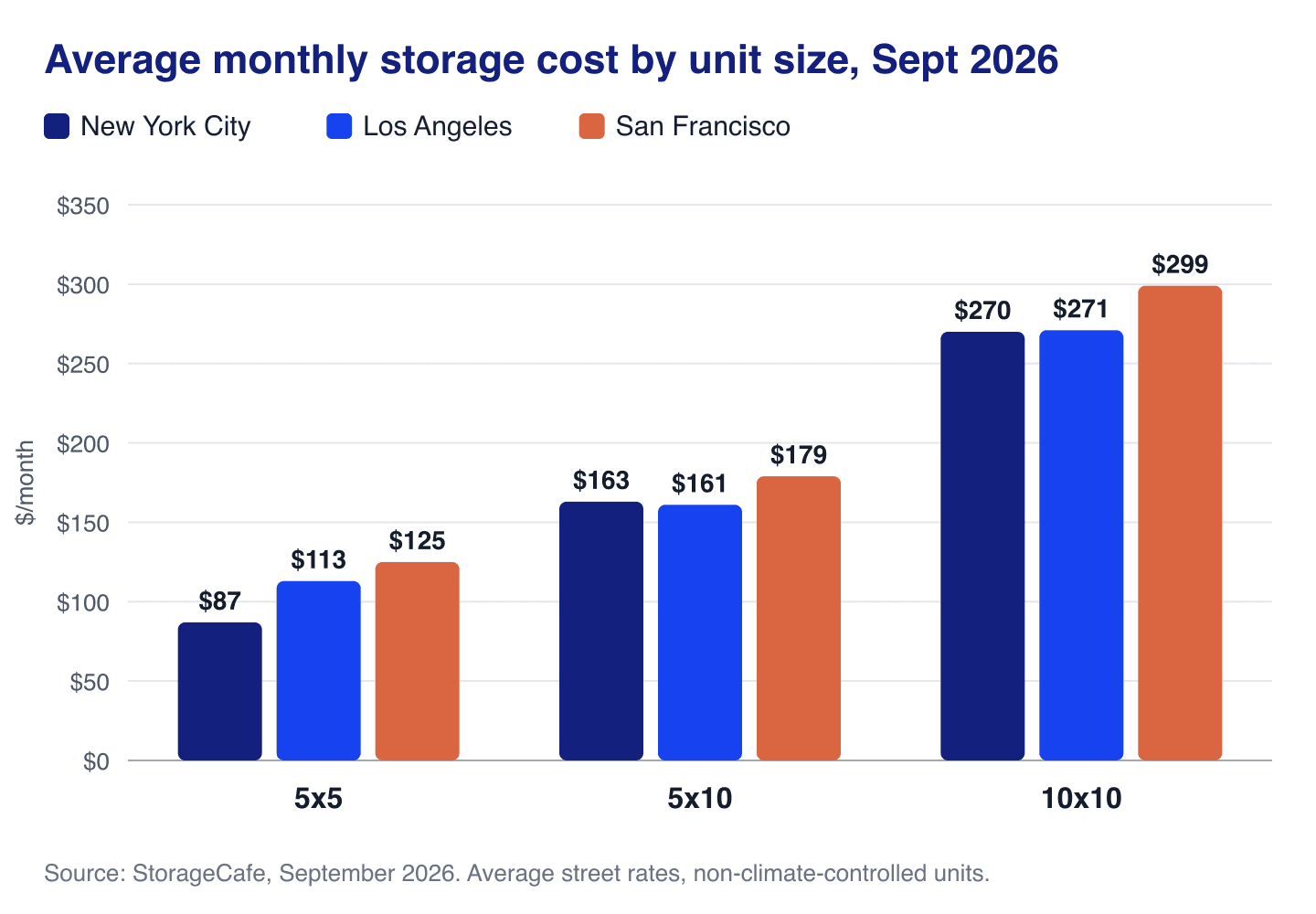
- A 5x5 storage unit averaged $87 to $125 a month in New York, Los Angeles and San Francisco in September 2026, and a 10x10 averaged $270 to $299 (StorageCafe).
- Compare every deal by its 12-month total: promotional months, the regular rate after them, one-time fees and insurance.
- The biggest savings come from renting a smaller unit. Over a year, a deep first-month discount matters less.
- Count the trip. A unit you can walk or take transit to costs less to use than a cheaper one across town.
A few terms you'll see on every listing: the street rate (or regular rate) is the standard monthly price; the promotional rate is a discounted price for the first month or few months; an admin fee is a one-time charge at move-in.
How Much Does a Cheap Storage Unit Cost in 2026?
A cheap storage unit in a big city costs roughly $87 to $125 a month for a 5x5 and $270 to $299 for a 10x10, based on StorageCafe's September 2026 street rates for New York, Los Angeles and San Francisco. StorageCafe puts the national non-climate-controlled 10x10 at roughly $119 to $126, so these three cities run more than double.
| Unit size | New York City | Los Angeles | San Francisco |
|---|---|---|---|
| 5x5 (25 sq ft) | $87 | $113 | $125 |
| 5x10 (50 sq ft) | $163 | $161 | $179 |
| 10x10 (100 sq ft) | $270 | $271 | $299 |
| 10x20 (200 sq ft) | $490 | $471 | $521 |
| 10x10 change vs. a year earlier | +1.1% | -5.6% | +2.1% |
Average monthly street rates for non-climate-controlled units, September 2026. Sources: StorageCafe for New York City, Los Angeles and San Francisco; national figure from StorageCafe's price guide. Retrieved October 2026.
Prices are drifting slowly. Yardi Matrix, the research firm behind StorageCafe's data, found that national advertised rates were down 1.9% year over year in August 2026, with New York City one of only four of the 30 largest metros where non-climate-controlled rates rose (REjournals, September 2026).
Two more patterns stand out. Size drives price far more than city does: a 5x5 costs about half a 5x10 in New York and about 70% of one in Los Angeles and San Francisco. And climate control adds little for small units. StorageCafe's climate-controlled 5x5 average in New York ($83) is actually lower than the standard one, and a climate-controlled 5x10 in Los Angeles ($179) costs about $18 more.
For the national picture, see our breakdown of self-storage costs across the US.
What Counts as a Cheap Storage Unit?
In New York, Los Angeles and San Francisco, a 5x5 at or under $87 in New York, $113 in Los Angeles or $125 in San Francisco, or a 5x10 at or under $163, $161 or $179, is at or below the September 2026 city average (StorageCafe). Compare the regular rate, not the first-month price, because the regular rate is what you pay for most of the year.
Why Isn't the Cheapest Advertised Rate the Cheapest Storage?
The cheapest advertised rate usually describes only your first month or two. A storage price has three parts: the promotional rate you see first, the regular rate you pay after it ends, and the fees and increases that land on top. Listings lead with the first.
Most storage rentals are month to month, which cuts both ways. You can leave whenever you like, and the facility can change your rate with notice. New York City now treats this as a consumer-protection issue: its Department of Consumer and Worker Protection requires self-storage facilities to be licensed and to give customers fee disclosures, under rules effective September 17, 2026.
What does a 12-month storage bill really look like?
Here's the 12-month math for a 5x10 on a large national chain's Los Angeles listing (October 2026): $77 a month online, $154 in-store from month 5, plus a $29 admin fee.
To be clear, this is another company's pricing, not Stuf's. We use it because this promo-then-jump pattern is common at big chains, and it shows why the advertised rate can mislead. For how a Stuf unit adds up over the same 12 months, see what a Stuf unit costs over 12 months below.
| Line item | What the ad suggests | What the terms add up to |
|---|---|---|
| Months 1–4 | $77 × 4 = $308 | $77 × 4 = $308 (assumes months 3–4 stay at the web rate) |
| Months 5–12 | $77 × 8 = $616 | $154 × 8 = $1,232 |
| Admin fee | $0 | $29 |
| 12-month total | $924 | $1,569 |
| Effective monthly cost | $77 | about $131 |
Snapshot from the chain's public Los Angeles listing for a 5x10, captured October 20, 2026. Promotions change often.
The listing only spells out months 1, 2 and 5–12, so we used the cheapest reading for months 3 and 4. If those months bill at the in-store rate too, the year comes to $1,723. Either way, add a protection plan if your renters policy doesn't cover stored items, since many facilities ask for proof of insurance or an approved coverage option.
Now the fair part. About $131 a month is still below the $161 Los Angeles average for a 5x10. The promotion is a reasonable deal, but its value depends entirely on how long you stay. Move out after month four and you've paid $337 for four months of storage. Stay two years and your rate can rise again on top of the $154.
The 12-month test: before you sign anywhere, ask for the regular monthly rate, the month it starts, every one-time fee, and whether insurance is required. Then add up a full year and compare that number between facilities.
Plan for a longer stay than you expect: a three-month promotion is a poor fit if your storage is tied to a move or renovation that could run 18 months.
Which Fees Change the Real Price?
Admin fees, required insurance and lock purchases are the three charges that most often separate the listing from the first bill. We go through every clause in our guide to what to ask before signing a storage contract, so here's the short version:
- Many large chains charge a one-time admin fee at move-in; $29 appeared on the national-chain listings we reviewed in October 2026. A few operators skip admin fees entirely, so it's worth asking.
- Insurance is often mandatory. Check whether your renters or homeowners policy extends to off-site storage before you buy a facility plan.
- Some facilities sell you a lock at move-in, while others include one. Ask.
Then there's the increase that arrives after you've moved in. Our guide to storage rent increases explains why they happen and how to respond to a notice.
Pickup or "valet" storage has its own version of this problem: the monthly rate can look low while delivery and retrieval fees add up each time you need something back. See the FAQ below for how it compares.
How Do I Find Cheap Storage Units Near Me?
To find cheap storage units near you, shortlist three facilities within a short walk, bike ride or transit trip of home, then compare their 12-month totals for the same unit size. The cheapest unit is the one with the lowest total including the trip.
Where to search
Start with a map, not a search results page. Map and local listing apps show what's actually near you and how long it takes to get there:
- Google Maps or Apple Maps: search "storage units near me," then check walking, biking or transit time from your door, opening and access hours, recent reviews and photos of the building.
- Bing Places (in Bing Maps): worth a second look, since its local listings and rankings can differ from Google's.
- Yelp: read the newest reviews for mentions of surprise fees, rent increases and how easy it is to get in and out.
- Nextdoor or a neighborhood group: ask neighbors what they pay and whether the price went up after the first few months.
Once you have three nearby options, run them through these four steps:
- Pick the smallest size that fits what you're storing.
- Ask each facility for the regular rate and the month it starts.
- Add one-time fees and insurance, or check your renters policy.
- Add the cost of getting there for the visits you expect.
What's the Cheapest Way to Store Your Things?
The cheapest way to store your things is to rent the smallest unit that fits, close enough to reach without a car, on month-to-month terms you can end the moment you're done. Here's what each lever saves, worked out from the September 2026 city averages above.
| Move | Example | Typical saving |
|---|---|---|
| Size down one step | 5x10 to 5x5 in NYC ($163 to $87) | $76/month, about $900/year |
| Size down from a 10x10 | 10x10 to 5x10 in NYC ($270 to $163) | $107/month |
| Share a unit | Split an NYC 10x10 two ways vs. your own 5x10 | $28/month each |
| Skip climate control where you can | LA 5x10 standard vs. climate ($161 vs. $179) | $18/month |
| Pick a no-admin-fee facility | Avoid a $29 one-time fee | $29 once |
| Time your exit | Leave before a promo's regular rate starts | The full rate jump, e.g. $77/month on the LA example |
How do I pick the right size?
Pick the smallest unit that holds everything with a little room to spare. Size is the biggest lever because it compounds every month, and it's easy to overestimate what you need. A 5x5 holds the contents of a packed walk-in closet: seasonal clothes, boxes, a bike, holiday decorations. A 5x10 fits a studio's worth of furniture. Our guide to storage unit sizes for city apartments translates each size into rooms of an apartment.
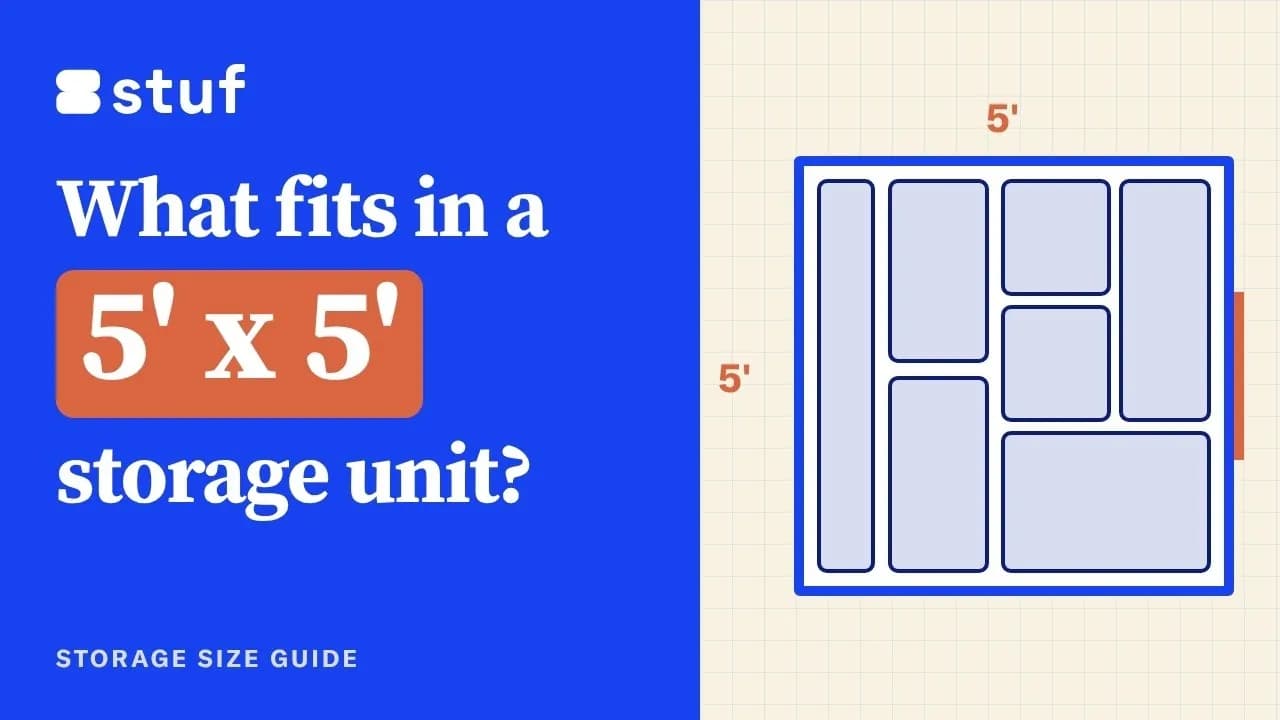
Watch: what fits in a 5x5 storage unit (33 seconds)
Some city facilities also rent units smaller than a 5x5, which is worth asking about if you're storing a few boxes and a suitcase.
Is storage cheaper in another neighborhood?
Usually, yes, but only the trip tells you whether it's worth it. StorageCafe's cheapest neighborhoods in September 2026 included Hunts Point ($119) and Concourse Village ($140) in New York, Chesterfield Square ($124) and Eagle Rock ($179) in Los Angeles, and Ingleside Heights ($197) and Inner Mission ($207) in San Francisco (all unit sizes combined, so treat them as a rough guide).
The real cost of storage includes getting to it: the car, the rideshare, or the half day lost to a facility off the freeway. A unit that saves $30 a month but needs a $20 rideshare each way stops being cheap after one visit a month.
Should I sign up month to month?
Yes, for most people. Month-to-month terms let you downsize or leave the moment you don't need the space, which is how you stop paying for empty square footage. Ask how much notice the facility needs and whether the last month is prorated.
Is a rate guarantee worth paying for?
Only if the increases it prevents would cost more than the guarantee. Some operators hold your monthly price for the first 12 months, sometimes as part of the standard offer and sometimes as a paid add-on. For a short stay, a paid guarantee usually isn't worth it.
Where Can I Find Cheap Storage in San Francisco?
In San Francisco, the cheapest approach is a small unit near home, chosen by its 12-month cost. A 5x10 averaged $179 and a 10x10 $299 a month in September 2026, up 2.1% on the year for the 10x10 (StorageCafe). The cheapest neighborhood averages were Ingleside Heights ($197), Inner Mission ($207) and Dogpatch ($227), all unit sizes combined.
Promotions are deep here, which makes the 12-month test essential. In the national-chain listings we reviewed in October 2026, several small and mid-size units showed web rates at half the in-store price, while some larger units carried no discount at all. Ask for both prices.
Our San Francisco locations sit downtown, on Kearny St, Sutter St and Vallejo St, close to where many people live and work, so a trip to your unit can be a walk instead of a drive. As of October 2026, 133 Kearny St in the Financial District listed a 5x10 at a regular $174 a month and a 10x10 at $300, right around the city averages, with any first-months discount shown next to the regular rate.
For neighborhood-level detail and fees, read our full guide to how much self storage costs in San Francisco.
Where Can I Find Cheap Storage in Los Angeles?
In Los Angeles, the cheapest storage is a right-sized unit you don't have to drive across the city to reach. LA averaged $113 for a 5x5, $161 for a 5x10 and $271 for a 10x10 in September 2026, with the 10x10 down 5.6% on the year (StorageCafe). Chesterfield Square ($124), Eagle Rock ($179) and Historic South-Central ($183) had the lowest neighborhood averages, all unit sizes combined.
The LA listings we reviewed in October 2026 showed the full range of pricing models. Some chains post half-price web rates that jump to the full in-store rate around month 5, plus a one-time admin fee. Others discount the first few months by about a third. A few lock the rate for 12 months and skip admin fees.
None of these is automatically cheapest. Run each through a 12-month total for the size you need, then add the drive. In a city built around freeways, a unit near home saves time as well as gas. Our Los Angeles-area locations are on Wilshire Blvd and in Koreatown, Glendale, Pasadena and northeast LA, inside buildings in the neighborhoods people already live in. As of October 2026, the Koreatown location on S Ardmore Ave listed an 8x5 (40 sq ft) at a regular $153 a month.
Our neighborhood guide to affordable self storage in Los Angeles breaks prices down from Silver Lake to Santa Monica.
Where Can I Find Cheap Storage in NYC?
In New York, the cheapest storage is usually the smallest unit you can reach by subway or on foot. NYC averaged $87 for a 5x5, $163 for a 5x10 and $270 for a 10x10 in September 2026, with the 10x10 up 1.1% on the year (StorageCafe). The cheapest neighborhood averages were in the Bronx and Queens: Hunts Point ($119), Concourse Village ($140) and Rockaway Beach ($148), all unit sizes combined.
The Brooklyn listings we reviewed in October 2026 followed the same promo patterns as the West Coast: half-price web rates against a full in-store rate, "first month free" offers paired with percentage discounts, and move-in discounts that apply to the first month only.
In a city where most people don't drive, distance is part of the price. A cheaper unit in another borough can cost more once you count the subway time or car service for every visit. That's why our New York locations are in neighborhoods across Manhattan, Brooklyn and Long Island City, and include closet-size units smaller than a 5x5. A small unit a few stops away works like an extra closet.
Not sure you need a unit at all? Start with how to tell if you actually need storage in New York.
What About Washington DC, Seattle, Boston and Atlanta?
The same 12-month test works in any city: regular rate, fees, insurance and the trip. We have neighborhood locations in all four: Washington DC, Seattle, Boston and Atlanta, so you can check what's near you and compare the regular rates. For DC prices by size and neighborhood, see our guide to self storage costs in Washington DC.
The Cheapest Unit Is the One You'll Actually Use
Good value in storage comes from a price you can plan around and a unit close enough that you'll actually use it. Rock-bottom headline rates rarely deliver either.
That idea is the basis of Stuf Storage, a neighborhood self-storage company with locations in San Francisco, Los Angeles, New York, Washington DC, Seattle, Boston and Atlanta. Its facilities turn underused space in neighborhood buildings (basements, garages and street-level spaces) into storage in the areas where people live and work. When your unit is a short walk, bike ride or subway trip away, it can work like an extension of your closet: you pop in for the winter coats or the camping gear without planning a car trip.
What does a Stuf unit cost over 12 months?
Here's the 12-month test applied to a real listing: the smallest unit at the Canal St location in Chinatown, New York City, a 4x3.75 (15 sq ft) closet-size unit, as listed in October 2026 with a regular rate of $81 a month and 50% off the first month and 25% off the second.
| Line item | Cost |
|---|---|
| Month 1 (50% off) | $40.50 |
| Month 2 (25% off) | $60.75 |
| Months 3–12 at the regular $81 | $810 |
| Admin fee | None listed |
| Lock | Included |
| 12-month total | $911.25 |
| Optional protection plan | From $9/month ($108/yr) |
That works out to about $76 a month before insurance, or about $85 with the entry-level plan. It assumes no rate change during the year; rates can rise, at most once every six months.
How does access work?
You get in with a digital key in your Member Dashboard, and your unit comes pre-locked with its code stored there, per the FAQ. Most Stuf locations are open 8am to 8pm, seven days a week. Check your location's page for its exact hours.
What are the rental terms?
Here's how we answer the questions to ask any facility, per our FAQ and member benefits page:
- Listings show the regular rate next to any first-months discount, so the 12-month math is visible before you book.
- Rentals are month to month, with 24 hours' notice to cancel. The final month isn't prorated.
- Every unit comes with a free lock. Insurance is required: use your own policy or add a Minico plan from $9 a month.
- Rates can rise, but never more than once every six months, with at least 30 days' notice.
If you're looking for cheap storage units near you, run the 12-month total on each option and count the trip. The unit that wins on both is your cheapest storage.
Frequently Asked Questions
Do I need insurance for a storage unit?
Usually, yes. Many facilities require proof of insurance or a protection plan before move-in. Check whether your renters or homeowners policy covers belongings stored off-site first. At Stuf, insurance is required: you can use your own policy or add a Minico plan from $9 a month.
Can two people share a storage unit?
Yes, and it's one of the easiest ways to cut the cost. Splitting a New York 10x10 ($270 a month in September 2026, per StorageCafe) two ways comes to $135 each, $28 less than renting your own 5x10. Agree up front on whose name is on the rental and how access will work, and check the facility's rules.
What is the cheapest storage unit size?
The 5x5 is the smallest standard size and usually the cheapest, averaging $87 a month in New York, $113 in Los Angeles and $125 in San Francisco in September 2026, per StorageCafe. Some city facilities rent even smaller closet-size units.
Are first month free and $1 storage deals worth it?
They can be, if you'll move out before the regular rate kicks in. Add up a full 12 months at the regular rate, plus admin fees and insurance, and compare that total with other facilities. In the listings we reviewed in October 2026, promotions covered one to four months, and the regular rate could be double the promotional one.
Can I cancel a storage unit anytime?
With a month-to-month rental, generally yes, but check the notice period and whether the final month is prorated. At Stuf, all rentals are month to month, move-out needs at least 24 hours' notice, and the final month's rent isn't prorated.
Is climate-controlled storage worth the extra cost?
For small units in these cities the premium is small or zero. In September 2026 a climate-controlled 5x5 in New York averaged $83, below the $87 standard rate, and a Los Angeles 5x10 cost $179 versus $161 (StorageCafe). Many people choose it for wood furniture, electronics, documents and fabrics.
Is pickup storage cheaper than a self-storage unit?
It depends on how often you need your things back. Pickup or valet storage can show a low monthly rate, but delivery and retrieval are often charged each time, so the cost rises with every access. A self-storage unit near home costs the same however often you visit.
What is a street rate in self storage?
The street rate is the standard monthly price a facility advertises for a unit, before promotions. It is the rate you pay once any move-in discount ends, and the number to use when comparing facilities over 12 months.
Do storage rates go up after you move in?
They can. Most storage rentals are month to month, so facilities can change your rate with notice. Ask how often rates change and how much notice you get. At Stuf, rates can rise at most once every six months, with at least 30 days' notice.
Storage without the fine print
One price, month to month terms, no hidden fees. Plus an extra $50 off each of your first 2 months with code STUFBLOG50.